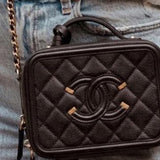
Chanel authentication comes down to seven checks, and they have to match the bag's era: serial stickers and cards through 2021, a metal chip plate after it. When the sticker, stitching, hardware and stamps agree with one another, you are looking at a real bag rather than a good copy.
Why does the era come first?
Chanel changed how it marks bags several times, and which serial system you check depends on the production year. The table below sets the timeline straight before we walk through the checks.
| Era | What marks the bag | What to verify |
|---|---|---|
| Mid-1980s to 1996 | Early serial stickers, six to seven digits; many have faded or peeled away | Remaining sticker format and placement; interior details that fit the age |
| 1997 to 2004 | Eight-digit serial stickers with matching authenticity cards | Card and sticker serials match; card typography fits the series |
| 2005 to 2021 | Eight-digit serials roughly in the 10 to 31 series on printed stickers | Sticker intact and matching the card; series number fits the year |
| 2021 onward | No sticker, no card: a metal plate with the microchip inside | Plate placement and finish; everything else on the bag supports the era |
For the full story on the newest era, read our explainer on the Chanel microchip.
Check 1: the serial sticker or chip plate
On pre-2021 bags, the sticker sits on the interior back wall, usually above or beside the inner pocket, printed with the CHANEL name, two CC logos and the serial number. The printing should be crisp and evenly spaced, and the number should be consistent with the era it claims to be from.
On 2021 and newer bags, look for the small metal plate with two data panels. It cannot be scanned with a phone, so judge it on placement, finish and how it sits in the leather.
Check 2: the authenticity card
From the 1990s through 2021, bags shipped with a card whose serial matches the sticker, and the card stock and typography changed across series. Line the number up digit by digit; a mismatch is an immediate stop.
One warning applies throughout: a card on its own proves nothing. Good fakes ship with cards, so the card only counts when it agrees with the bag.
Check 3: stitching and quilting
Chanel stitching is dense and even, with a classic benchmark of roughly 10 to 11 stitches per side on the diamond quilts of the Classic Flap. Deviations matter more than the exact count: wobbly runs, puckering or a quilt pattern that shifts out of alignment across seams are all warnings.
Turn the bag over as well. The exterior back pocket should sit squarely within the quilting, with the pattern continuing evenly on both sides.
Check 4: hardware and engravings
The CC turnlock should feel solid and operate with a firm click, and the engraving on its plates and screws should be crisp. Zipper pulls, grommets and chain links carry their own CHANEL stampings on genuine pieces, and they should all read cleanly at close range.
Hardware wear is normal; hardware that looks freshly plated on an old bag, or cast with soft, rounded lettering, is not.
Chanel, verified
Shop authenticated Chanel


Check 5: interior stamping
Look for gold CHANEL stamping with MADE IN FRANCE or MADE IN ITALY beneath it, placed where the model's layout calls for it. The lettering should be sharp, evenly spaced and correctly sized for the space it occupies, not stretched to fill it.
Newer models also carry a leather interior label, while older pieces rely on the stamping and tag placement. Compare several examples from the same era before you judge a single bag.
Check 6: leather and construction
Caviar leather should show an even, regular pebble across panels, and lambskin should feel soft with a gentle sheen rather than a plastic finish. Edge paint should be neat rather than thick or cracked, and linings should sit smoothly with tight, straight seams.
Material quality is one of the hardest things for fakes to copy at scale, which is why texture deserves as much attention as any stamp.
Check 7: the whole picture
Individually, each of the six checks can be faked; together, they are very hard to fake consistently. Superfakes exist, and some pass several checks before falling apart on one detail, which is why authenticators look at the bag as a whole: era, provenance, wear patterns and repairs.
For the tells that apply across brands, see how to spot a fake designer handbag. When the stakes are high, in-hand authentication by trained experts is still the standard, and it is how every piece in our Chanel collection is vetted before it is listed.
What photos should you request before buying?
- Both panels of the chip plate, or a close shot of the serial sticker, in sharp focus and without glare;
- Both faces of the authenticity card, if the bag is pre-2021;
- Close-ups of the CC turnlock, zipper pulls and any engraved hardware;
- The interior stamping and the full interior layout;
- Corners, strap and flap edges, where wear or sloppy construction shows first;
- Receipts or service records, if any exist.
A seller who dodges these requests is answering a different question for you.
When should you walk away?
Some signals end the conversation immediately: a serial number that does not match the card, a suspiciously fresh sticker on an old bag, hardware with soft or rounded lettering, or a seller who refuses close-up photos. Trust the aggregate, not any single detail, and never let a low price rush the checks.
Frequently asked questions
Where is the Chanel chip located?
Inside the bag on a small metal plate, usually on the interior back wall or beside the inner pocket, and placement varies slightly by model. The plate cannot be read with a phone, so judge it by placement, finish and the rest of the bag.
Do all Chanel bags have serial numbers?
Leather goods have been serialized in some form since the mid-1980s, but older stickers often fade or peel away entirely. From 2021, the serial lives on the microchip inside the metal plate rather than on a visible sticker.
Can a fake have a real serial number?
Yes. Fakes routinely copy serials from genuine bags, and authenticity cards are sold separately online. A number only means something when the sticker or plate, the card and every other detail tell the same story.
The LDJ edit